Stop guessing how people use your technology.

Rafał Tryścień

Instead of guessing, use cognitive research to see what users truly perceive, understand and do with your technology.

Book a call

Dean of Cognitive Science at AHE ŁódźPhDCognitive ResearchEye-TrackingBiometrics

Technology evolves faster than our understanding of people.

Companies build advanced products and platforms, yet still make decisions based on assumptions about how people read, understand and focus their attention. Those assumptions are often wrong.

Assumptions about the interface

You design something that feels intuitive to you. But the user doesn't see what you see. 40% of people will click somewhere else entirely.

Pressure versus understanding

You know the message should be clear. But what if people simply can't read it under time pressure, with their attention divided?

Behaviour vs. what people say

Surveys and interviews tell you what people think. Eye tracking and biometrics show how they actually react. That's a completely different story.

Who this collaboration is for

I work with companies and teams that build human-centred products and genuinely want to understand how people use them.

01 / UX & Research

Product and interface research

Do users really understand your interface? Discover where they look, what stops them, what pulls their attention away and the moment they start to get lost. With eye tracking and observation in laboratory conditions you'll see how people actually use your product.

  • Usability testing with eye tracking
  • Cognitive analysis of the interface
  • Recommendations for UX/UI teams
02 / AI & Humans

Human–AI interaction research

Do users really trust your AI solution? See how they use artificial intelligence, which elements they understand, where resistance appears and what makes them start to lose trust. Behavioural research reveals users' real reactions, not just what they say in a survey.

  • Testing AI models in real conditions
  • Trust and transparency research
  • Optimising the user experience
03 / Communication

Communication and marketing research

Do your audiences see in your campaign what you intend to convey? See which elements attract attention, what stirs emotion and whether the message leads to the right associations. Eye tracking and emotional biometrics let you measure a campaign's effectiveness beyond what audiences merely declare.

  • Testing messages and materials
  • Analysis of emotional reactions
  • Optimisation for effectiveness
04 / Education

Education and learning-process research

Does your online lesson truly lead the learner to understanding? See where the participant loses focus, which parts of the material are too difficult and what helps them retain the content better. Cognitive research shows how to design courses, training and e-learning platforms so knowledge is easier to absorb.

  • Analysis of learning processes
  • Testing educational materials
  • Recommendations for course design

Cognitive Research Laboratory AHE Łódź

An interdisciplinary research space where psychology, neuroscience, philosophy of mind and product design meet technological practice. We study perception, attention, emotions, decision-making and human behaviour in contact with technology, to better understand how people actually use products, interfaces, systems and digital tools.

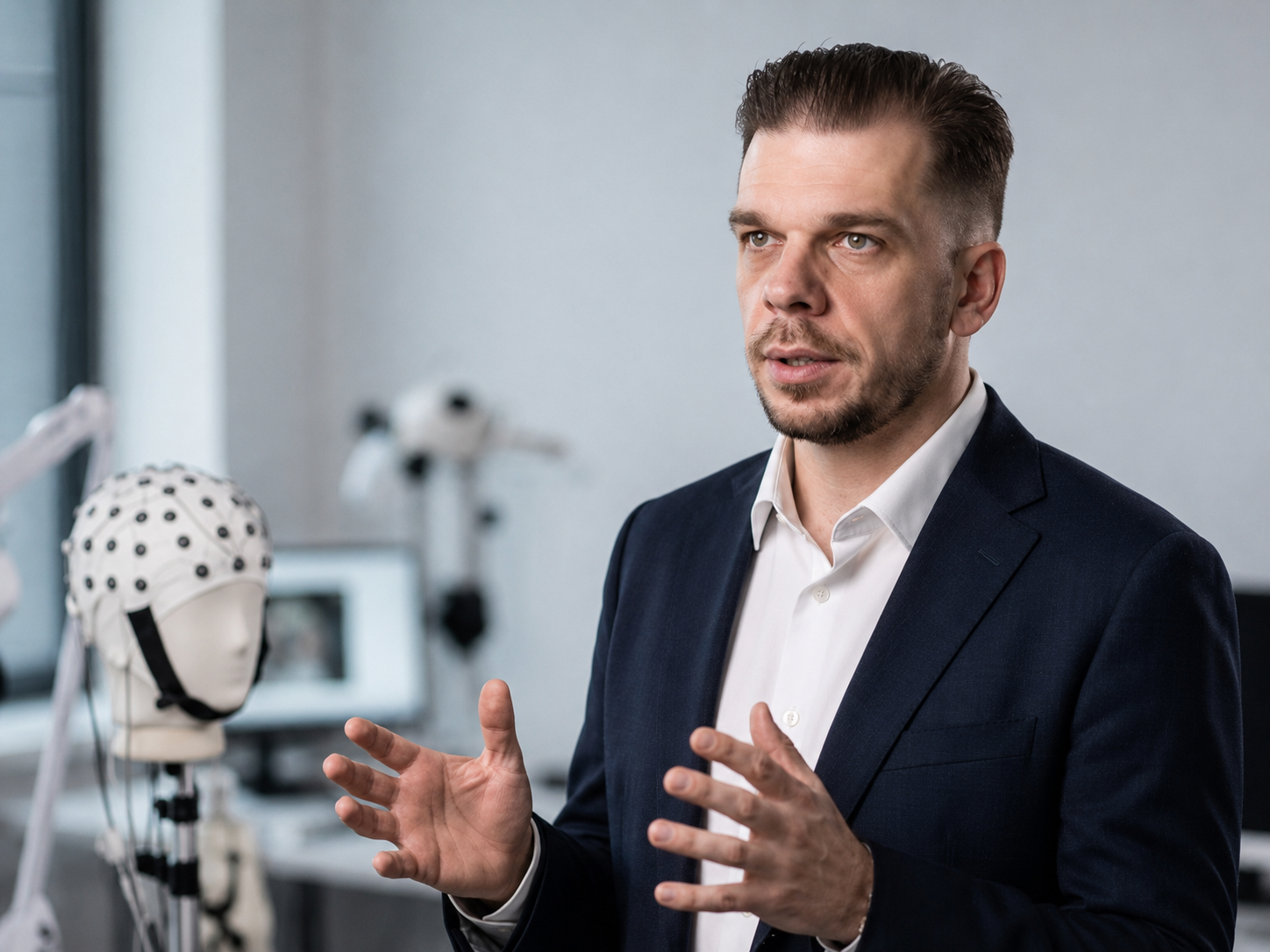
Rafał Tryścień in the Cognitive Research Laboratory beside EEG equipment

Eye tracking

We check where the user looks, what attracts their attention, which elements they skip and at what moment they begin to get lost.

Biometrics (GSR, ECG, EMG)

We measure psychophysiological responses such as stress, arousal, engagement and emotions during contact with a product or message.

EEG and advanced neurotechnology

We analyse brain activity during interaction with a product, interface, content or message.

Full behavioural observation

We record, observe and code user behaviour in controlled conditions to see how they really use a product.

What we can study

The laboratory lets us answer questions that can't be explored well through surveys or interviews alone. We observe users' real behaviour, their attention, emotional reactions and the moments when they lose orientation, interest or trust.

  • Usability testing of interfaces and applications
  • Analysis of campaign communication effectiveness
  • Education and e-learning research
  • Testing AI products and chatbots

More applications

We support partners at various stages of product development, from concept research, through optimising finished solutions, to validating campaigns and communication.

  • Advertising and consumer decision-making
  • UX research for technology startups
  • R&D projects for companies investing in research
  • Behavioural research for the finance and security sectors

What we can build together

Have a question about your users, product or technology? Let's turn it into research that helps your company make a better decision. I offer flexible forms of collaboration, from a one-off consultation, through a research pilot, to a long-term partnership.

01

Research consultation

Have an idea, product or problem you want to understand better? During the consultation we define which questions are worth asking and how cognitive research can help your company make a better decision.

02

Pilot research project

The first step to testing a product, interface or message with real users. A small project using eye tracking, biometrics or behavioural observation quickly shows what works and what needs improving.

03

Full laboratory project

A comprehensive study of a product, interface, campaign or AI solution in controlled laboratory conditions. We combine different methods to see how users really react, decide and use technology.

04

Long-term partnership

Ongoing research collaboration for companies that want to develop their product based on real user behaviour. I support your team as a scientific and research partner through the next stages of technology development.

Every project starts with the right question

Before I propose any research, I want to understand what you truly need to find out. We talk about your product, your users, your goals and the decisions facing your team. Only then do I select the method, scope and form of collaboration that can deliver real business value. Book a short, no-obligation call.

A scientist who understands business systems

Rafał Tryścień, PhD

Rafał Tryścień, PhD

My experience combines cognitive science, philosophy of mind, scientific research and business practice in the financial sector. This helps me support technology companies, investors and product teams in better understanding how people make decisions, where they lose trust and how they react to products, messages and digital systems.

Academic role

Dean of Cognitive Science at AHE Łódź

I lead the cognitive science programme, developing a curriculum that connects the science of the human mind with technological and business practice. I work with students on real research projects for companies and organisations.

Scientific education

PhD in the humanities, philosophy of mind and personal identity

My academic foundation covers philosophy of mind, consciousness, personal identity and ethics. This lets me see the human being not only as a product user, but as a person who interprets, trusts, decides and reacts.

Research work

Mind, consciousness, AI, identity, ethics

I publish and speak at conferences in Poland and abroad. My work covers philosophy of mind, consciousness, the problem of personal identity, ethical aspects of artificial intelligence and questions about machine consciousness.

Business experience

Compliance, AML, FATCA, CRS, decision systems

I work in the financial sector, analysing processes related to risk, regulatory compliance and decisions made within complex systems. This means I understand both the theory and the practical needs of business.

What we research

My scientific work addresses questions that increasingly appear in the technology business as well. How people think, decide and trust technology. How they understand messages. How they react to artificial intelligence. How to interpret consciousness, identity and responsibility in a world of ever more complex systems.

Selected areas:

  • Philosophy of mind and consciousness
  • The problem of personhood and identity
  • Ethics of artificial intelligence
  • Machine minds and their moral status
  • Applied cognitive science in business

Who I've worked with

  • Danske Bank

    Compliance, Risk & Analytics

  • Nordea, ING, EY

    AML, FATCA, CRS processes

  • Chancellery of the Polish Sejm

    Expert advisory

  • Coach & Mentor

    Training in communication and critical thinking

Certificates

  • ICA Diploma (UK)

    AML & CTF Compliance

  • FIU Poland

    Compliance and anti-money laundering

  • CoachWise Essentials

    ICF

  • TOEFL 620

    Clark University

A simple collaboration process.

01

Strategic conversation

I start by getting to know your questions, goals and challenges. Together we determine what's truly worth studying and what problem sits behind the need for research. On that basis I propose the best direction.

02

Research design

I translate your goals into specific research questions and hypotheses. I select the right methods, such as eye tracking, biometrics or behavioural observation, and then plan the entire research process.

03

Conducting the research

We run the study in the laboratory or in the field, depending on the project's goal. We collect data on users' attention, behaviour, emotions and reactions in contact with a product, interface or message.

04

Insights for business

We analyse the results and prepare practical recommendations. We show what's worth changing, what to test next and which decisions can improve the product, communication or user journey.

Questions people usually ask.